
There’s a specific kind of frustration that comes with waking up to a breakout at 32.
You did everything you were supposed to. You grew up, cleaned up your diet, found a routine that worked, and assumed that acne was something you’d simply aged out of. And then it came back. Sometimes worse than before. In places it never used to appear.
If this sounds familiar, you’re not imagining things, and you’re not alone. Adult acne is genuinely common, genuinely different from what most people experienced as teenagers, and genuinely misunderstood, which is why so many people are still treating it with the wrong approach years into the problem.
The version of acne you learned about in your teens doesn’t apply here
Teenage acne is largely driven by puberty. Rising androgen levels trigger the sebaceous glands to produce more oil, pores get congested, and breakouts follow. It’s predictable, widespread, and in many cases resolves on its own as hormone levels stabilize.
Adult acne doesn’t follow the same script.
For adults, the triggers are more varied, more personal, and significantly harder to identify. Hormonal fluctuations continue well beyond puberty, particularly for women, across menstrual cycles, through perimenopause, and in response to conditions like PCOS. Stress elevates cortisol, which in turn stimulates oil production. Gut health, sleep quality, certain medications, and even skincare products that were designed to help can all contribute.
The result is acne that doesn’t behave predictably, doesn’t always respond to the treatments that worked at 16, and doesn’t conveniently disappear when you ignore it.
It shows up differently, too
Teenage acne tends to concentrate in the T-zone and presents frequently as surface-level breakouts: blackheads, whiteheads, and pustules that are visible and often manageable with standard over-the-counter products.
Adult acne is more likely to appear along the jaw line, chin, and lower cheeks. It tends to sit deeper in the skin, presenting as cystic or nodular breakouts that don’t come to a head, are painful to the touch, and linger far longer than a typical teenage pimple. These aren’t surface congestion issues. They’re inflammatory responses happening deeper in the tissue, which is why products targeting surface oil often do very little.
This distinction matters a great deal when it comes to treatment. Applying a teenage acne logic to adult acne is one of the most common reasons people stay stuck.
Why the standard advice keeps failing you
The internet is full of acne advice that assumes a single, universal skin type dealing with a single, universal problem. Harsh cleansers, heavy-duty benzoyl peroxide, aggressive exfoliation: these approaches can work for certain teenage skin types dealing with surface congestion. Applied to adult skin, particularly skin that’s also managing dryness, sensitivity, or early signs of ageing, they often make things worse.
Adult skin has less natural resilience. Stripping it of oil doesn’t reduce acne long-term. It disrupts the skin barrier, triggers a compensatory oil response, and creates an environment where inflammation is more likely, not less.
Generic protocols are built for no one in particular. Adult acne, with its layered triggers and individual patterns, rarely responds to them for long.
Tired of protocols that don’t fit your skin? AGE LESS Laser+Clinic offers custom acne skincare in Victoria, built around your specific triggers, skin type, and history.
The hormonal piece is bigger than most people realise
For many women dealing with adult acne, hormones are the central variable that every other intervention is working around.
Breakouts that appear consistently in the week before a period, acne that worsened after coming off the contraceptive pill, or skin that has never quite settled since a pregnancy: these are all patterns with a hormonal signature. And they require a different approach than acne driven primarily by congestion or external irritants.
Treating hormonally driven acne without addressing the hormonal component is like mopping the floor while the tap is still running. You can manage the surface, but the underlying driver keeps producing the same result.
A good consultation will always ask about cycle patterns, recent hormonal changes, and any diagnosed conditions that affect hormone levels. If yours doesn’t, that’s useful information too.
What effective adult acne treatment actually looks at
Because adult acne is more varied in its causes, effective treatment tends to be more layered in its approach. A few things that distinguish a considered plan from a generic one:
Skin barrier assessment.
Adult skin that has been over-treated, or treated with products designed for oilier teenage skin, often has a compromised barrier. Rebuilding that is sometimes the necessary first step before any active acne treatment can work properly.
Trigger identification.
Diet, stress load, product ingredients, hormonal patterns, sleep: a thorough intake process should be mapping these before recommending a protocol.
Inflammation versus congestion.
Deeper, cystic breakouts require anti-inflammatory approaches. Surface congestion responds to different interventions. A plan that doesn’t distinguish between these is likely to underperform.
Scarring as a separate concern.
Adult acne tends to leave more lasting marks than teenage acne, partly because skin cell turnover slows with age. If scarring is already present, that needs its own attention alongside active breakout management.
Not sure what’s actually driving your breakouts? The first step is understanding your skin, not buying another product. Book acne consultation in Victoria at AGE LESS Laser+Clinic and get a clear picture of what’s happening and what will actually help.
Why adult acne responds better to professional treatment
Over-the-counter products are formulated for the broadest possible audience. They can manage mild, surface-level acne in people whose skin happens to fit the assumed profile. For adult acne, particularly the cystic, hormonally influenced, or long-standing kind, they are rarely sufficient.
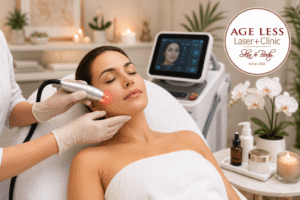
Professional treatments have access to a wider range of tools: prescription-strength actives, laser and light-based therapies that target inflammation and bacteria beneath the skin’s surface, chemical peels calibrated to skin type and concern, and the ability to adjust the approach based on how the skin is actually responding over time.
If you’ve been cycling through products for months or years without meaningful change, the issue likely isn’t that you haven’t found the right cleanser. It’s that the treatment category itself isn’t matched to the problem.
Acne at any age deserves a plan built around you
Adult acne is not a cosmetic inconvenience you should have outgrown. It’s a genuine skin condition with real causes, and it responds to treatment when that treatment is designed around what’s actually driving it.
The difference between spinning your wheels and making real progress usually comes down to one thing: whether your treatment plan was built for your skin specifically, or for the average skin that product manufacturers imagine when they’re filling a shelf.
That gap is where professional care earns its place.
Ready to stop guessing? AGE LESS Laser+Clinic provides the best acne treatment in Victoria British Columbia for adults who have tried the generic route and are done with it.